What a bartender walks through to become certified.
Not a training afternoon and not a certificate anybody can print. A path that starts with a link in a message and ends with a credential a stranger can check, and a place in the tool the industry already runs on.
What follows is that path, step by step, with the actual screens a bartender passes through. The examples use Priya, who is not real. Everything else on these screens is.
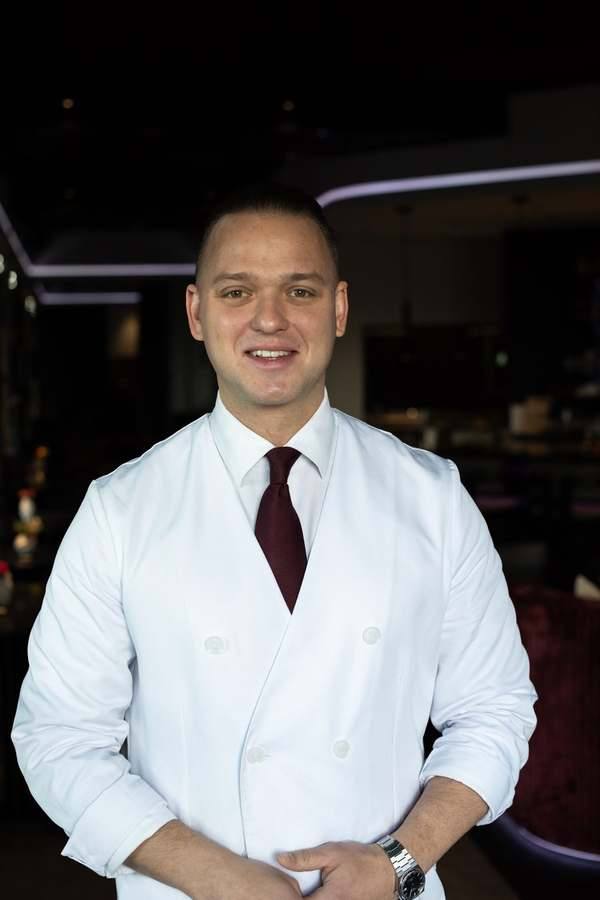
Adrian Michalcik
Modern Classicist, from Slovakia. Founder of About Contrasts in Oslo. His program, A.R.T. of Bars, gives this course its frame: Audience, Routines, Taste.

Kai Myhre
Creator of the Cheat Code series. He founded Cocktail Club, consumer and hospitality tool, to give everyone the cheat codes to amazing cocktails, without the stuffy rules.
Two authors, two halves. Kai made the craft simple enough for anyone to host with. Adrian built the professional frame underneath it. “A cheat code is not a shortcut. The knowledge is the cheat code.”
Eight steps, about three hours, and nothing to install.
No account to create, no app to download, no classroom to be in. A bartender does this on the phone already in their pocket, in whatever gaps the week leaves them.
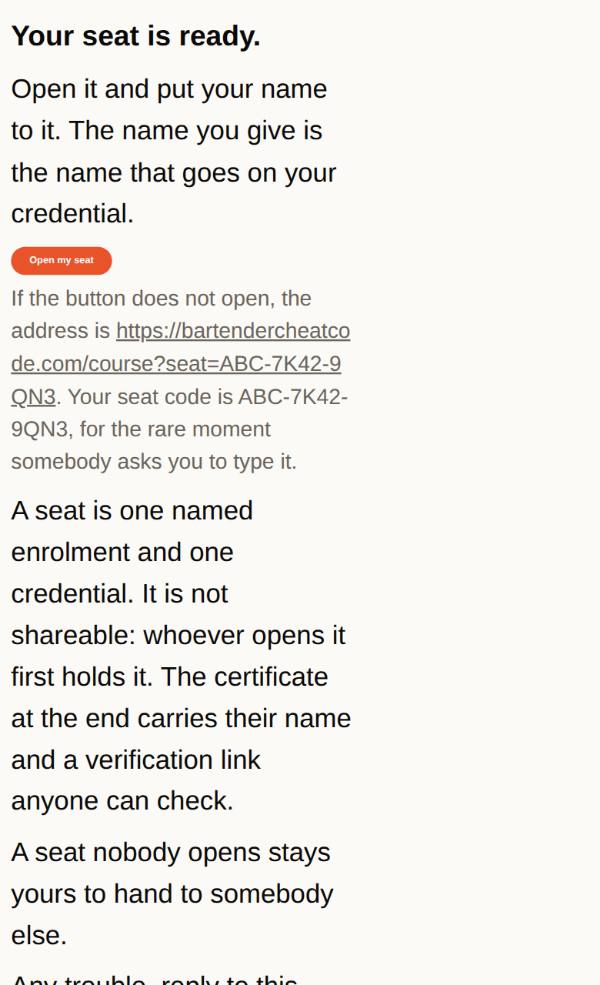
A link arrives
Somebody has bought a seat and sent it on. It arrives as one line to press, with the code underneath in case anyone ever asks her to type it.
A seat is one named enrolment and one credential. It is not shareable: whoever opens it first holds it for good. Until somebody opens it, the person who bought it can still hand it to somebody else.
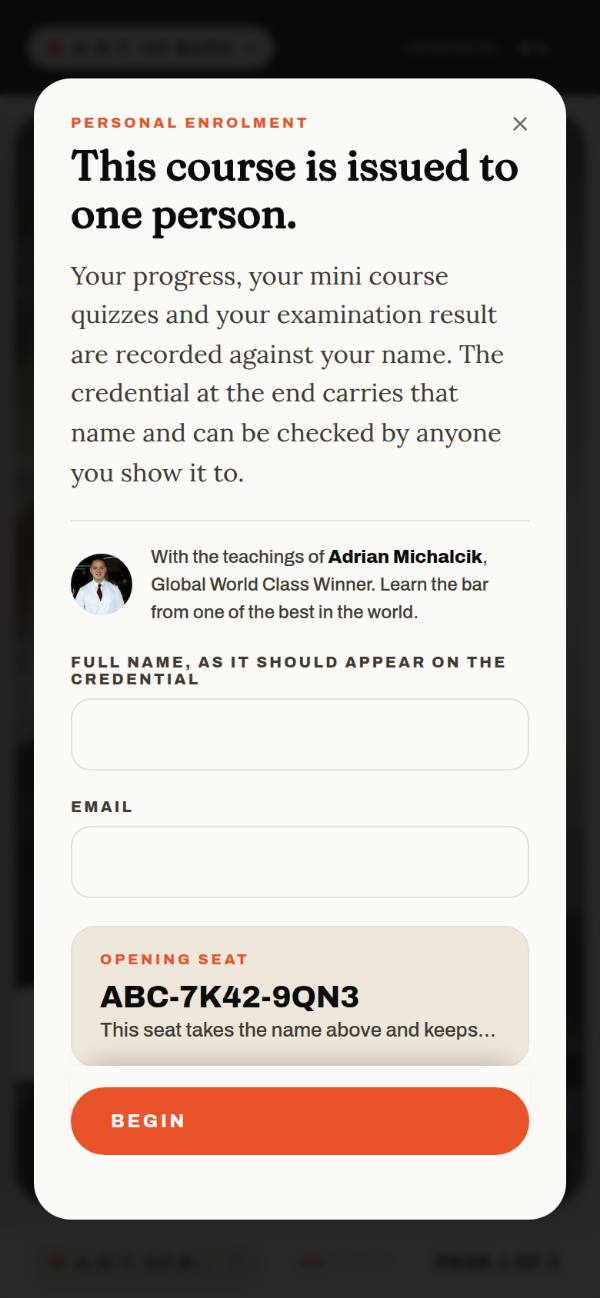
She puts her name to it
The first screen does not ask her to sign up for anything. It says what the seat is, and asks for the name that will go on the certificate.
This is the moment the seat stops being a code and becomes a person. The name she types here is the name an employer will read later, so the screen says so in as many words rather than burying it.
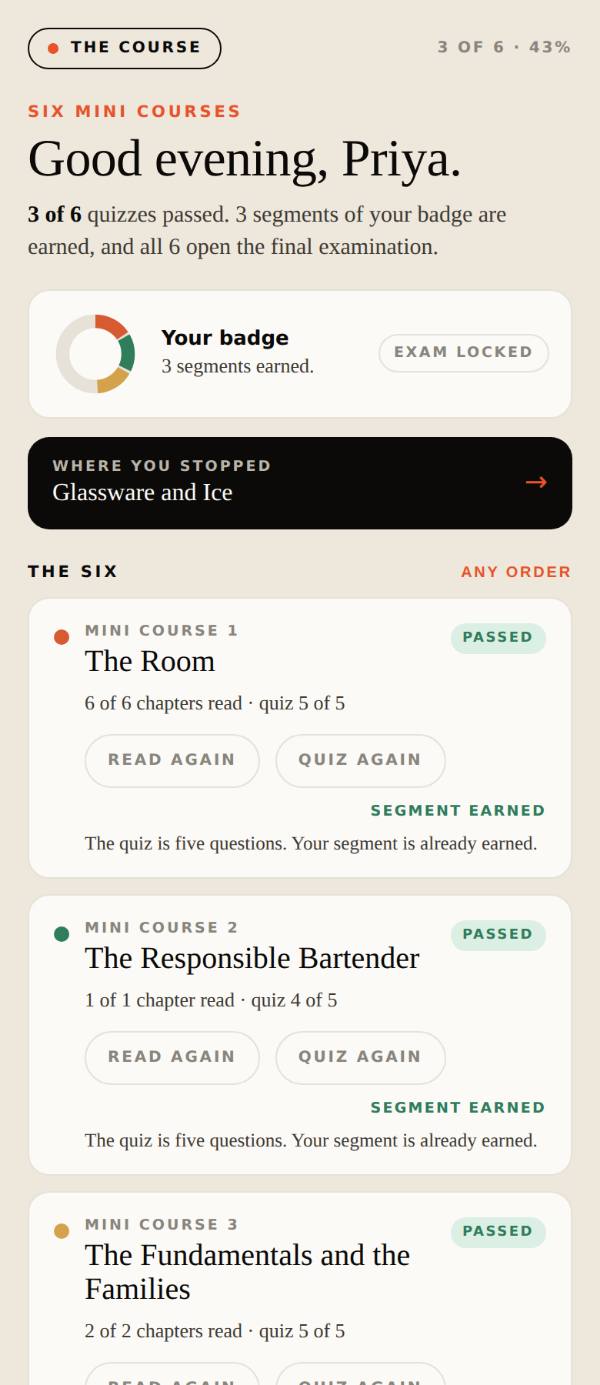
The course opens, and it knows where she is
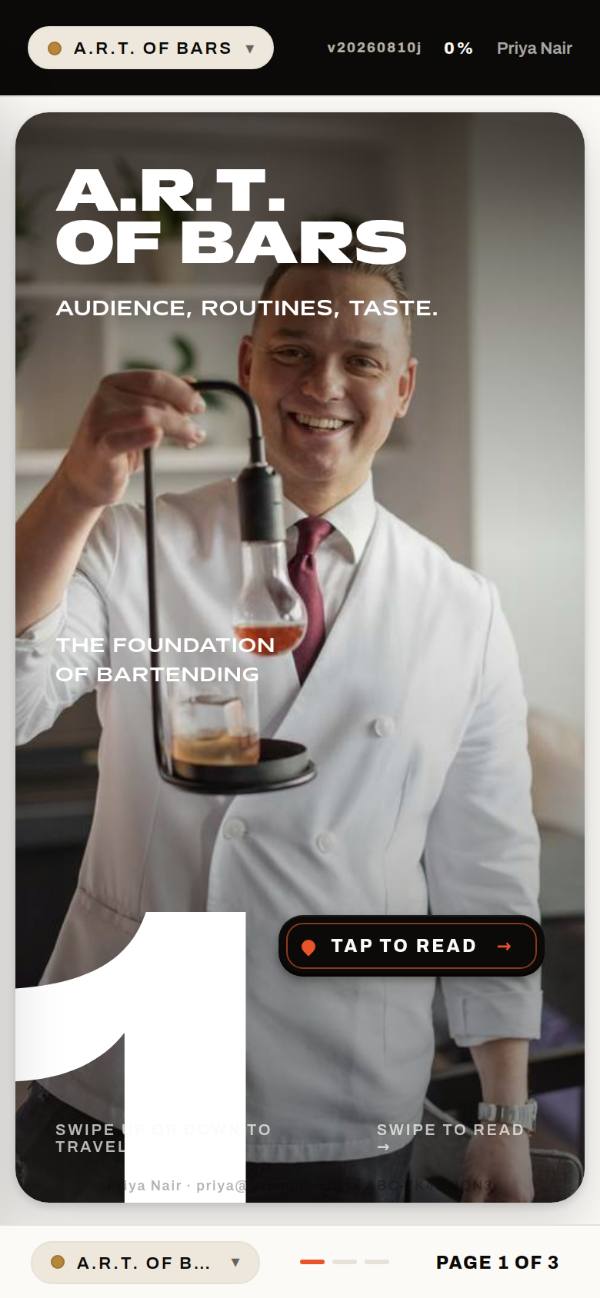
Six mini courses, twenty three chapters, about three hours of reading in total. She can take them in any order, or set it to open one at a time.
The ring at the top is her badge. It fills one segment per mini course passed. Her place is held against the seat rather than against the phone, so she can start on the bar and carry on at home without losing anything.
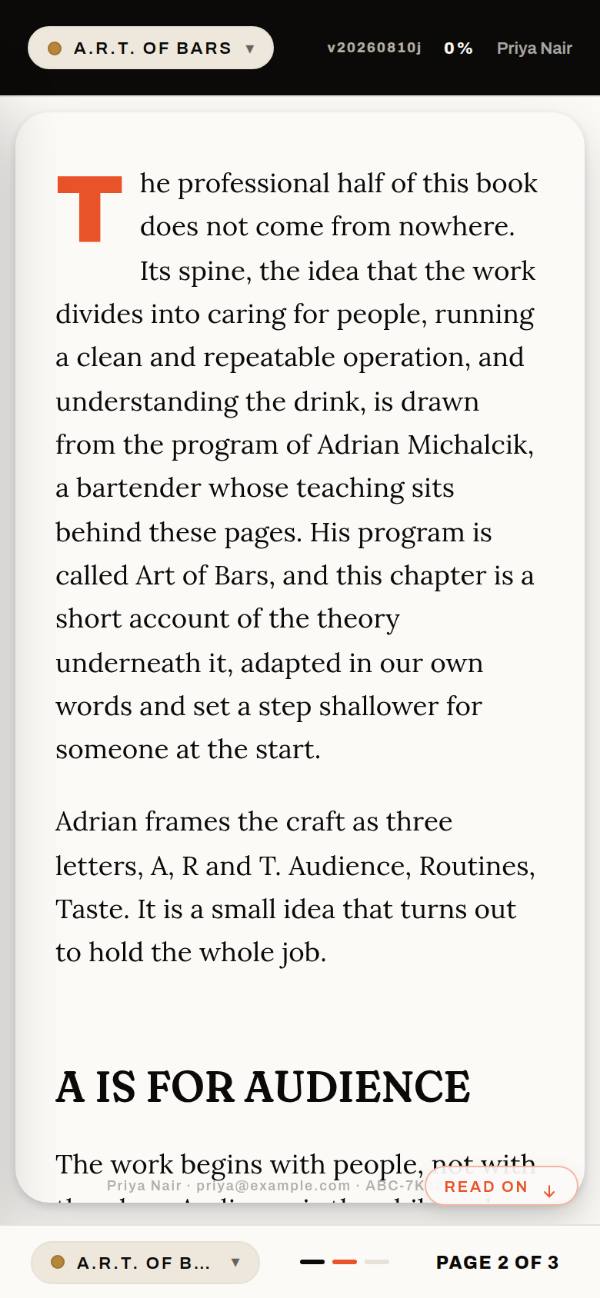
She reads it like a book, not a slide deck
Each chapter opens on a full page and then reads in short beats, sized for a phone held in one hand. There are films from Adrian inside the chapters, and recipes she can open without losing her place.
This is the half that most training skips. Not a list of drinks to memorise, but why drinks are built the way they are, which is the part that still works when a guest asks for something that is not on the list.
A quiz arrives when she finishes a mini course
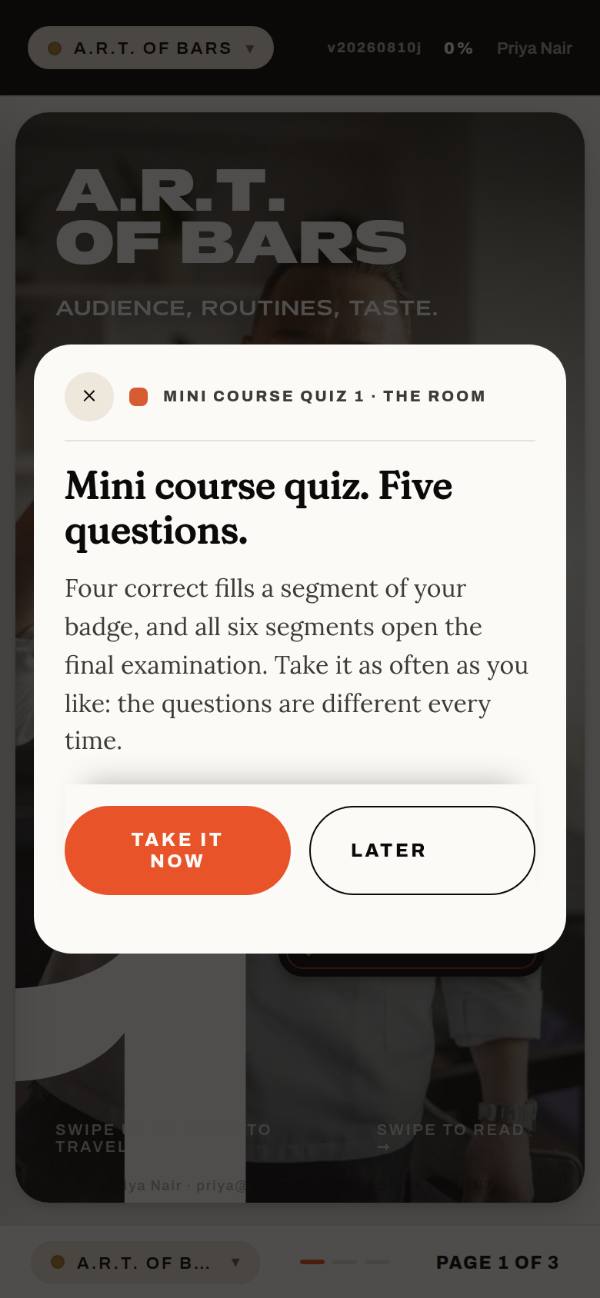
It is not thrown at her mid chapter and there is no box sitting in the corner waiting. It comes at the end of the reading, once, and it can be declined.
Five questions, four correct to pass, and the questions are different every time so a second go is not a memory test of the first. Passing fills one segment of the badge.
Six segments open the examination
It cannot be opened before all six are passed, and that is checked on the server rather than by hiding a button. Nobody sits and watches her. The clock is what defends it.
Forty seconds is long enough to answer something she knows and not long enough to go and look it up, which is the whole point of it. If she does not pass, she is shown which questions she missed and which chapters to read again.
Fifteen questions, sat alone, forty seconds each.
- 15Questions
- 40sOn each
- 11To pass
- 3Goes a day
She ends up with something she can show somebody
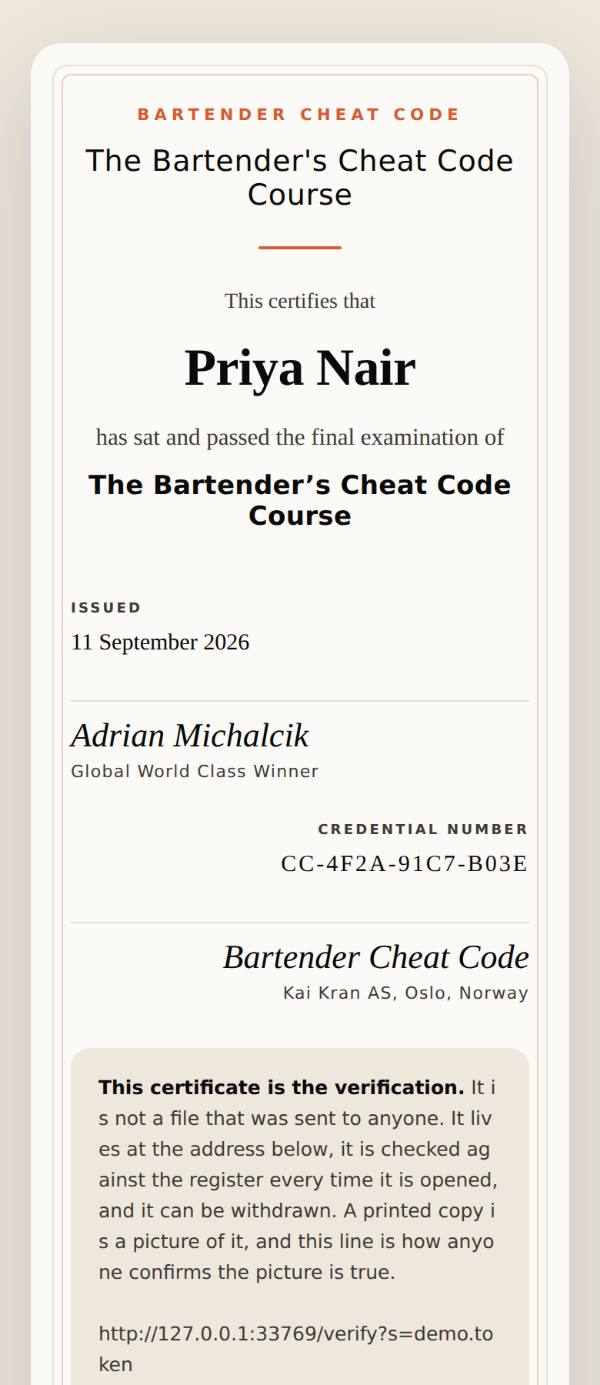
A certificate carrying her name, the date, a credential number, and Adrian’s name under it. It is not a file that was emailed to her. It lives at an address, and it is checked against the register every time it is opened.
That is the difference. She can send that link to a hotel group in another country and they get a straight answer about whether it stands, without having to take her word for it or ring anybody.
And then it goes where the work is
A certificate sitting in an inbox is worth what the person holding it can do with it. The point of finishing is not the page. It is being findable by somebody hiring.
Two things are broken at once, and they are the same problem from opposite ends. A venue that needs a trained bartender has no way to find one, so it hires whoever walks in and starts again from nothing. And a bartender who is good has no way to see the jobs worth taking, above all the ones in another country, so they hear about them from a friend or they do not hear about them at all.
The register is both halves of that. A venue searches by city, by who is open to offers, by what somebody can actually do. A role does not publish without the money on it. And the bartender’s own page carries the credential at the top, then the career underneath: where they have worked, what they opened, what a venue has confirmed and what they have only declared.
Two of these three are now built. They were drawings on this page a week ago. The record and the venue search are running on the preview site today, and the chapter below is photographs of them rather than drawings. The third, a posted role with the pay on it, is still a drawing.
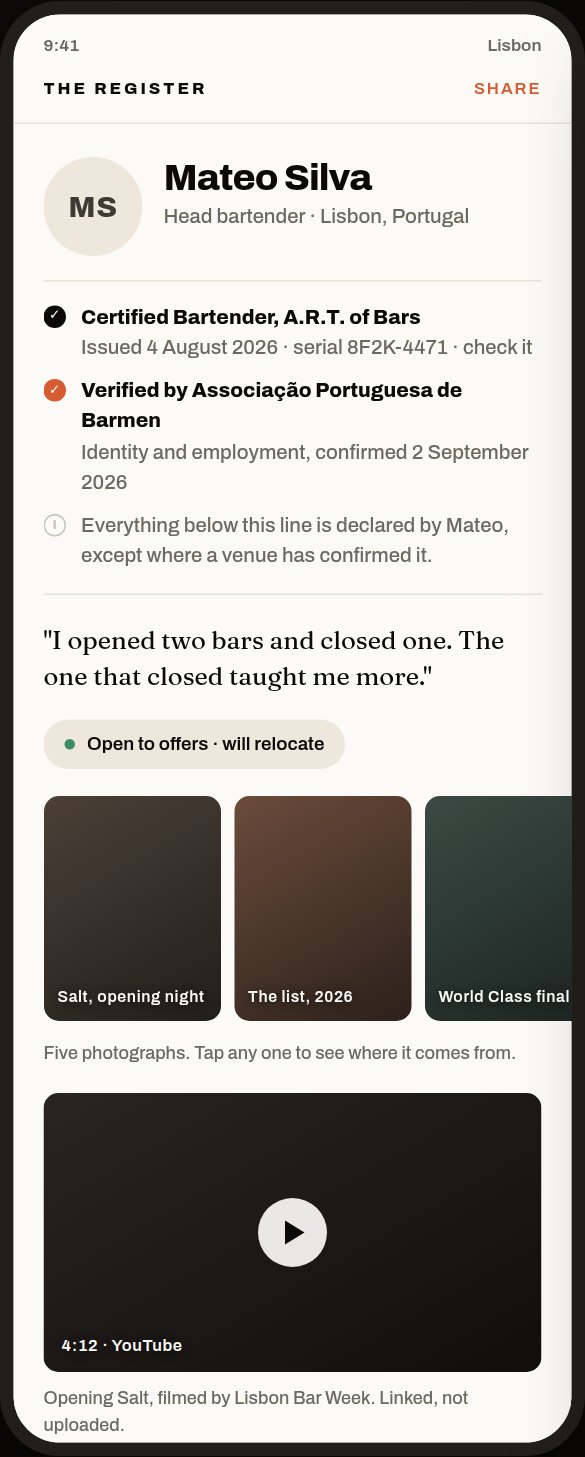
Built, on preview
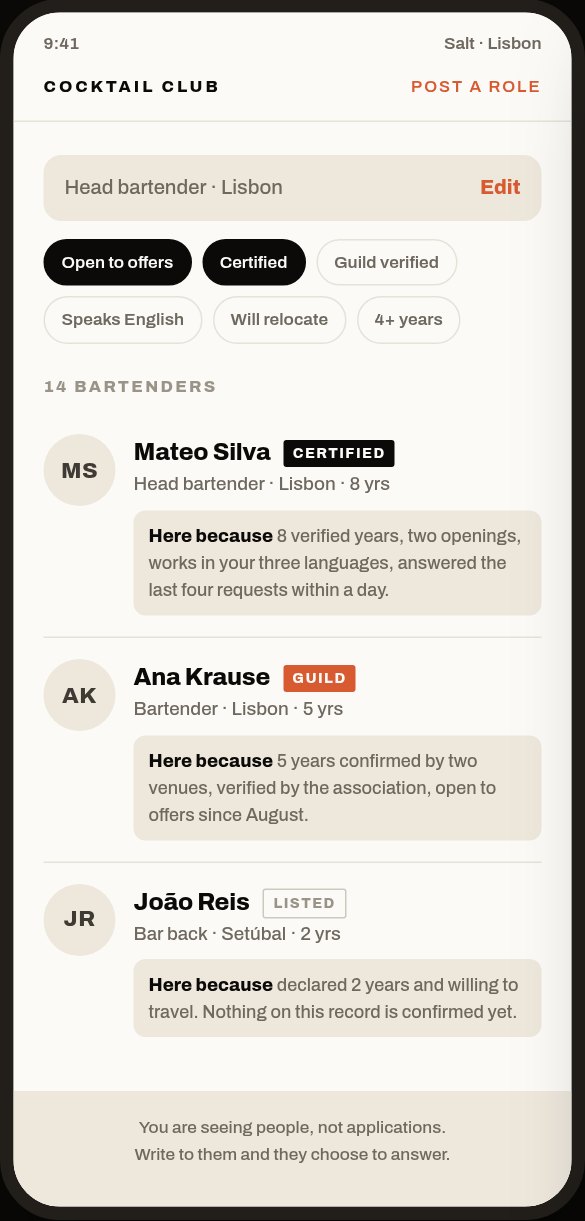
Built, on preview
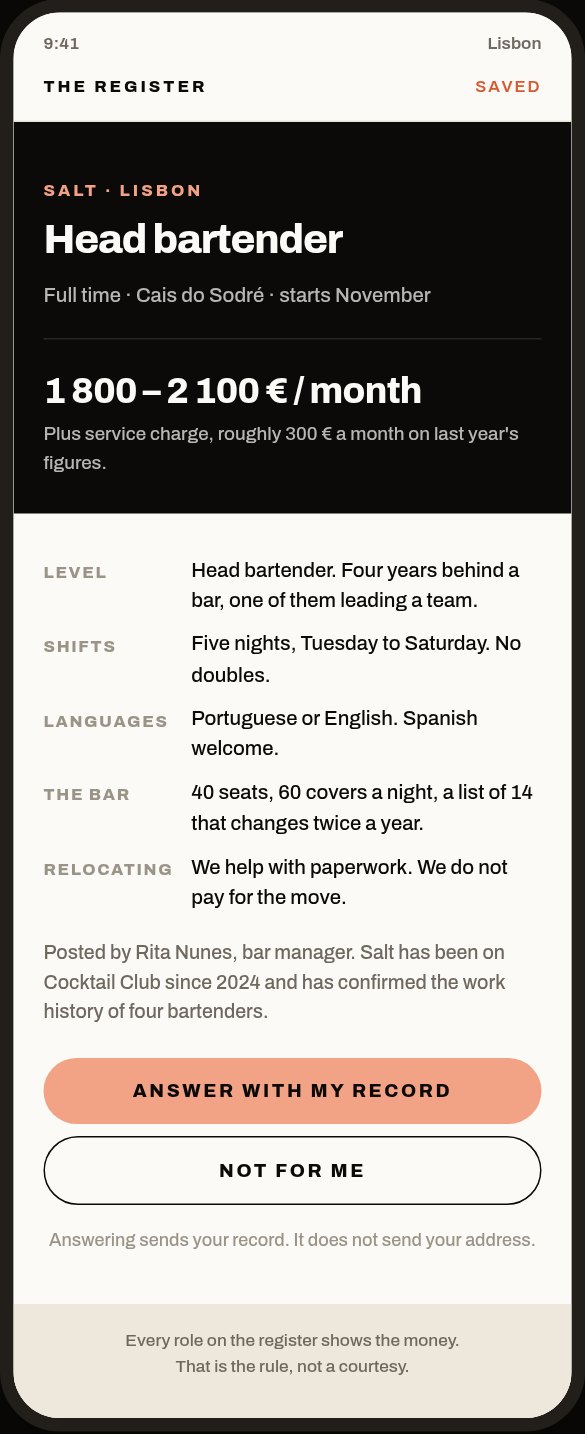
Drawn, not built
The Cocktail Club universe
Cocktail Club is the hospitality tool bars and hotels run their day on. Its clients asked for a way to train their staff, and this course is that answer. So the credential does not end up somewhere separate from the industry. It ends up inside it.
- Every graduate will be represented on cocktailclub.com with the credential, a CV, and the work they have done.
- That is where hotels and bars already using Cocktail Club will look for staff, which is international by default rather than local by accident.
The directory on cocktailclub.com is not open yet. Pass the examination and your place in it is yours the day it opens.
You can see the course itself here.
The record. Her career at an address, written by her and checked by nobody else.
This part is built and it is not public yet. Every screen below is a photograph of it running, taken this week on the preview site, with Priya’s own answers in it. Where something is still to come it says so on the line.
It starts with the drink she is proudest of
Not her name, not her email, not a form. The first thing a bartender is asked is what they pour that they are proud of, and it is hers from the moment it saves.
She can stop right there and still have got something. The drink is saved to her own recipes whether or not she ever fills in the rest, which is the answer to a blank page asking a stranger for their life story.
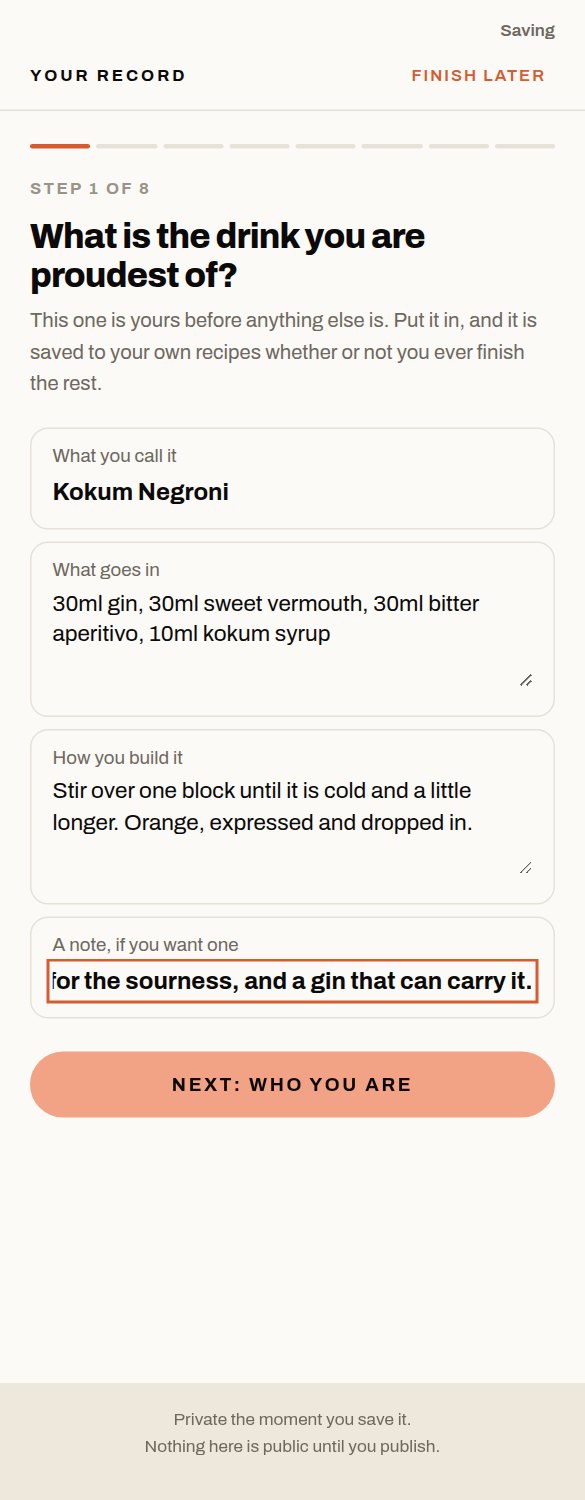
Built, on preview
A career, not a job history
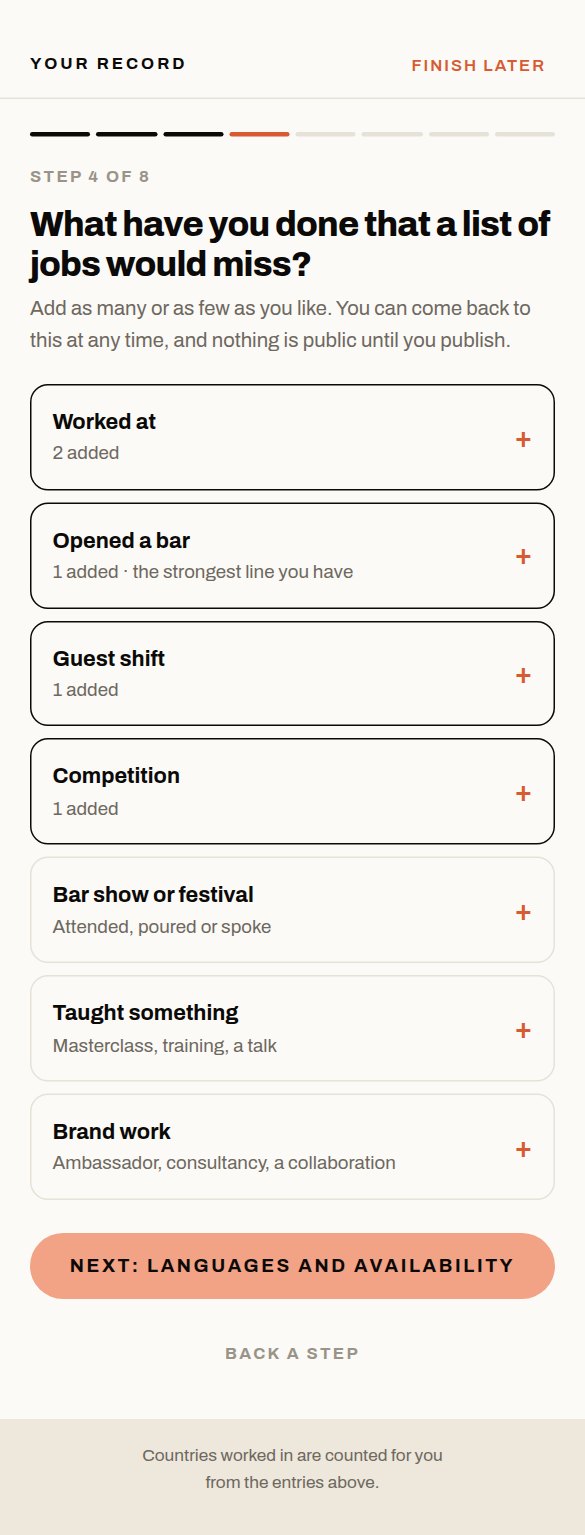
Eight steps, none of them longer than a phone screen, and every one saved as she leaves it. Step four is the one that makes a record different from a CV: bars worked in, bars opened, guest shifts, competitions, shows, what she has taught, brand work.
A bar opening is a line a CV has nowhere to put. Here it has its own section and its own count, and a bartender with one job sees one section rather than six empty ones.
Built, on preview
The one line she cannot type in
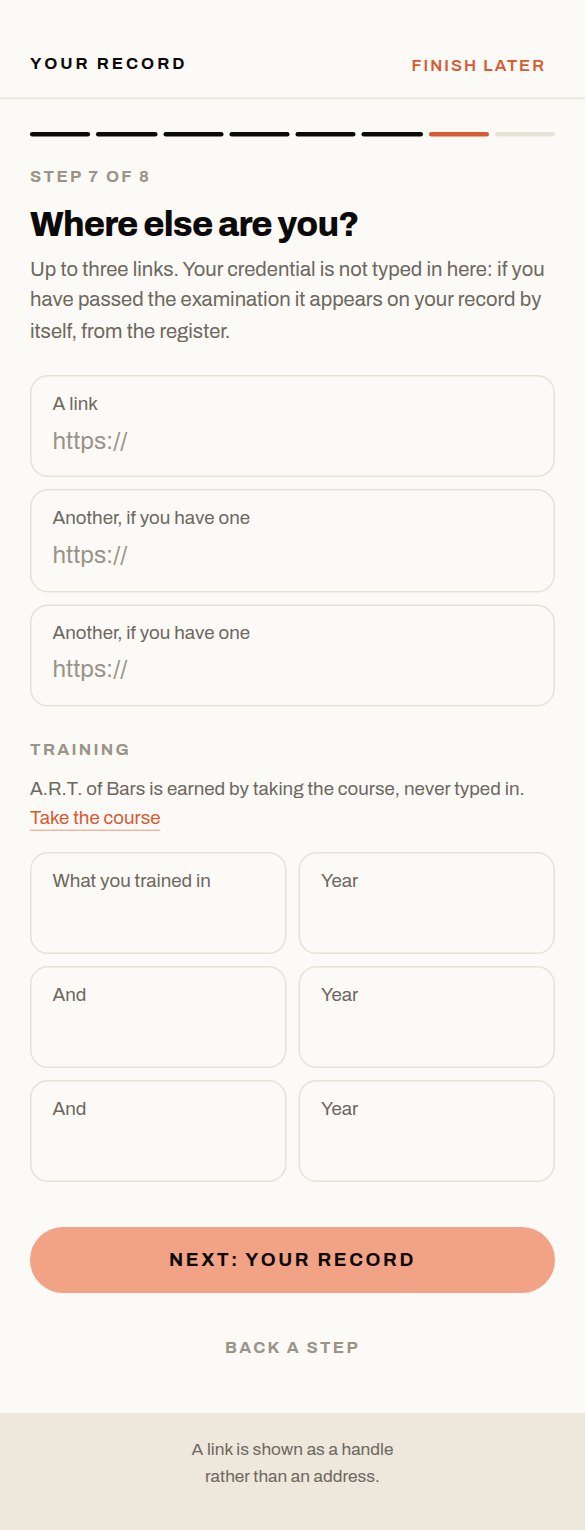
Everything on the record is hers to write. The credential is not. There is no box for it, no upload and nothing to tick, because a box beside a credential is where somebody starts claiming one.
The step says where it comes from and offers the way to get it, and that is all. If she passes the examination it appears on her record by itself, from the register. Until then it is a faded line with a link on it.
Built, on preview
She publishes it herself, after saying it is true
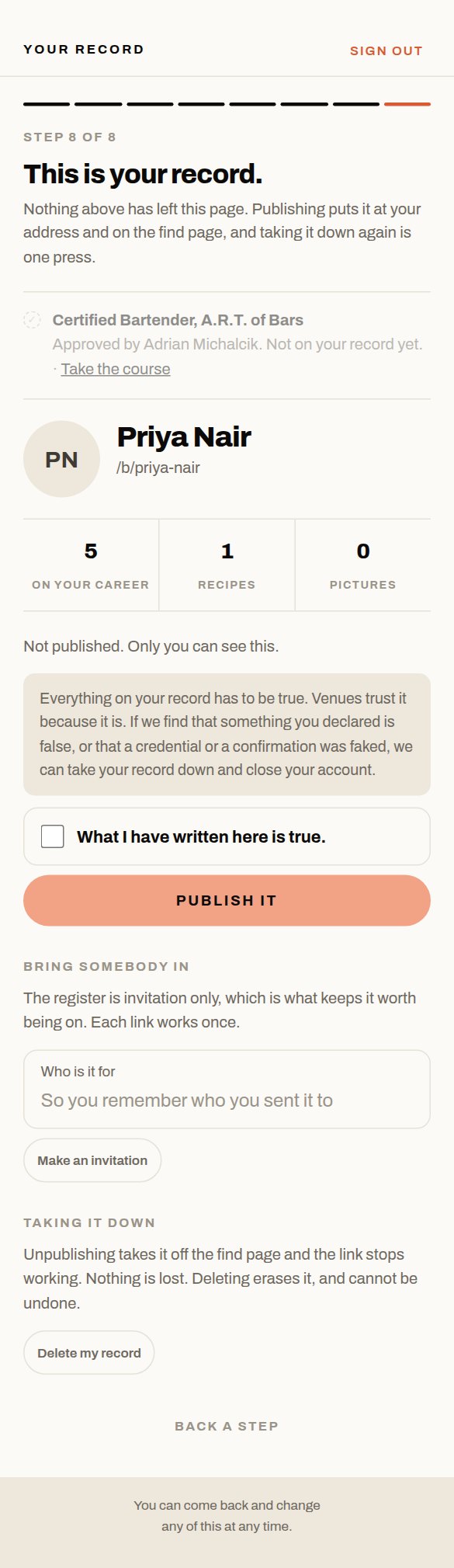
Nothing she has written has left the page yet. The last step shows her what she has, what the register says it stands behind, and the credential she has not earned, faded, with the way to earn it.
Then one sentence in her own language and one box: what I have written here is true. The tick is required to publish and not to save, and it is written down on its own before anything goes up, so what the log holds is the promise rather than a side effect of a button.
Publishing is her press, and taking it down again is one press. Nobody at Cocktail Club publishes a bartender.
Built, on preview
An address she can send, and a CV she can print
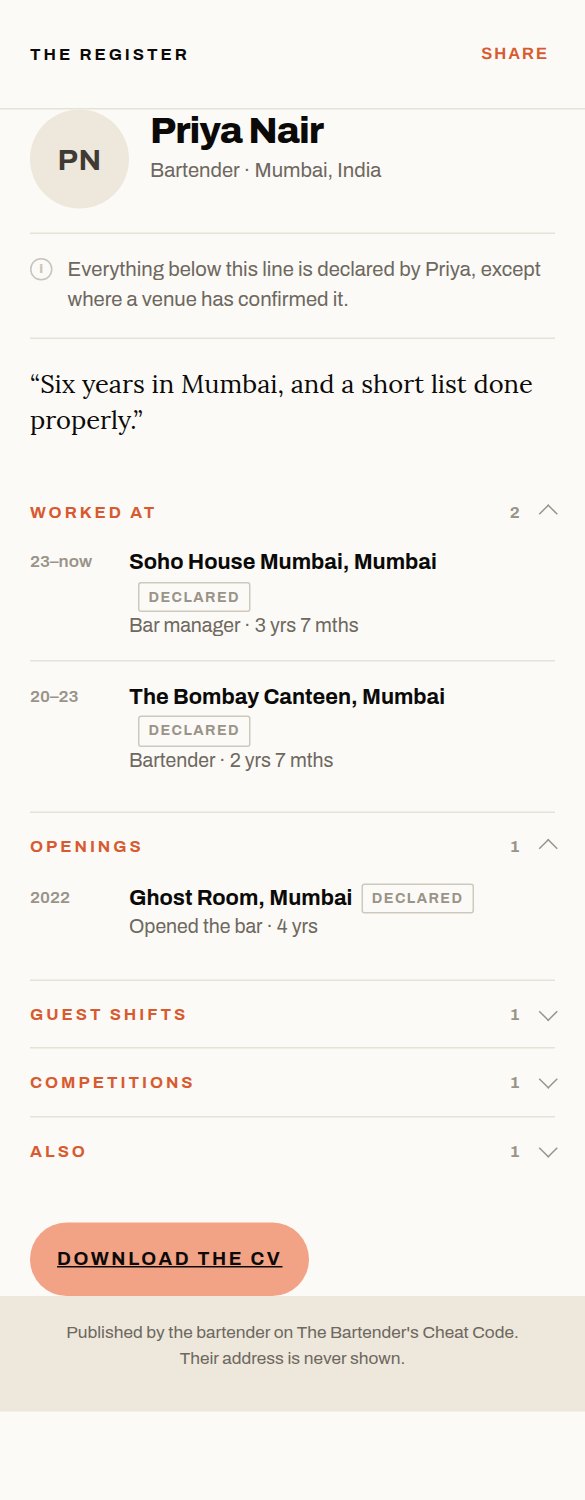
Her record lives at her own address. Anybody holding it reads the same page, with a line at the top saying plainly that everything below it is her declaration except where a venue has confirmed it.
The same record comes out as a one page CV, which is what a hotel group still asks for. She downloads it, or has it sent, and her address is never on the page a stranger opens.
Built, on preview
A venue finds her, and still does not have her address
A venue on Cocktail Club searches by city, by language, by who is open to offers. Every result carries the reason it is there in plain words, counted from the record rather than written by us: three years behind a bar, one opening, works in English, Hindi and Marathi, nothing confirmed yet.
The weakest case is said as plainly as the strongest, because a line that only ever flatters is one nobody believes twice.
The venue writes and we carry the message. Neither side has the other’s address until Priya answers yes.
Coming. A bartender who has a booking agent can hand the requests to them. The relay is built and the agent’s own way in is not, so today the agent is named on the record and the messages still reach the bartender.
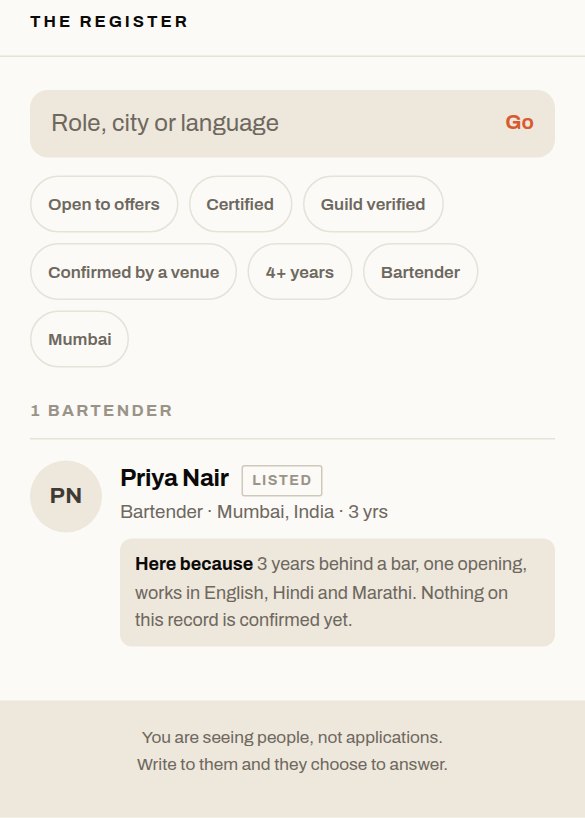
Built, on preview
Cocktail Club is the operational tool the hospitality industry runs on.
A bar’s own recipes, its menus and the daily routines behind the pass all live in it, kept current by the venue rather than in somebody’s head or on a printout taped inside a cupboard door.
That is what makes the credential worth something operationally rather than only on a CV. The course puts the craft underneath a bartender and covers part of the compliance education a venue would otherwise run itself. The tool keeps them up to date with what this venue serves tonight. Staff come to a shift prepared, and to a new job ready.
-
This venue’s spec, not a generic one
Every recipe and every menu the bar builds lives in the tool and changes the moment the bar changes it. Nobody is pouring last season’s build.
-
The routines, not just the drinks
The daily work behind the bar sits alongside the recipes: what happens at open, during service and at close. The part that is normally learned by watching somebody who is busy.
-
An operations guide, already written
The venue’s way of working does not have to be invented per site. There is a guide for it, so a manager is starting from something rather than from a blank page.
-
Part of staff compliance, already covered
The second mini course of the course is The Responsible Bartender, the duty that comes with the job. That is staff compliance education a venue would otherwise have to run itself.
-
A new hire starts on day one
Someone joining opens the tool and works from the venue’s actual spec instead of the nearest person’s memory. The course has already given them the foundation to read it with.
-
In the pipeline
Full compliance, and the graduate directory
Compliance in full is being built. So is the directory: every graduate represented with their credential, a CV and the work they have done, where hotels and bars already using Cocktail Club will look for staff.
 Open Cocktail Club
Official partner of the International Bartenders Association.
Bartending has never had a line on a CV that somebody else could check.
Experience is a claim. A reference is a phone call. A course certificate is usually a PDF that proves somebody sat in a room. These are the three things this changes.
It is verifiable by a stranger
The certificate is the verification. Anybody holding the link gets a live answer from the register, and a withdrawn credential says so rather than going quiet.
It belongs to the bartender
The seat binds to her name for good, and what she earned on it stays hers. She keeps it when she changes bar, city or country. The bar bought the seat; she owns the credential.
It fits around shifts
Three hours of reading and ten minutes of examination, on her own phone, with her place held against the seat. No rota to move and no room to be in.
Build it once.
The record is free. The course is a separate thing, and you do not need it in order to have one.
Free. Part of the Cocktail Club universe.
The Bartender’s Cheat Code Course. Written by Adrian Michalcik and Kai Myhre. Part of the Cocktail Club universe.
Every screen on this page is a photograph of the real product. The ones marked on preview are built and running and not public yet. The one marked drawn, not built is a design. Priya Nair is an example, the record shown is hers and nobody else’s, and the credential number shown belongs to no one.